The Biology of
How We Smell
Smell is the only sense with a direct connection to the brain regions that govern memory, emotion, and behavior. Understanding that connection starts at the receptor level.
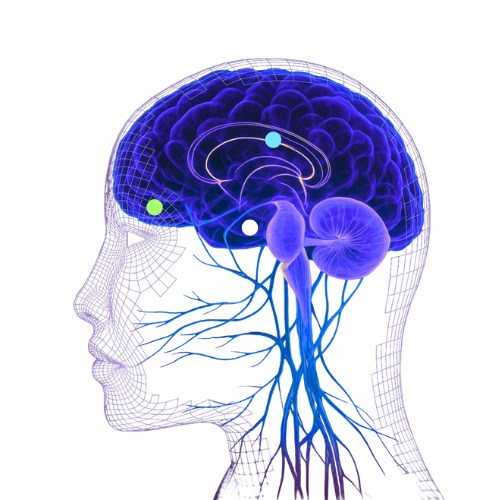

From Molecule to Signal
Every scent experience starts with a molecule binding to a receptor protein. The cascade that follows is fast, specific, and deeply wired into the brain.
- Odorant molecules bind to OR (olfactory receptor) proteins on olfactory sensory neuron cilia
- ORs are GPCRs with defined binding pockets tuned to specific molecular features: chain length, functional groups, 3D conformation
- The OR superfamily is the largest multigene family in the human genome, with ~390 functional genes and ~465 pseudogenes
- Ligand binding activates the Golf alpha subunit, stimulating adenylyl cyclase III to produce cAMP
- Rising cAMP opens cyclic nucleotide-gated ion channels, triggering calcium influx and membrane depolarization
- A single binding event becomes an electrical signal within milliseconds, amplified at every step
- OSNs expressing the same OR gene converge onto the same glomerulus in the olfactory bulb
- Roughly 1,000 neurons feed each glomerulus; the bulb contains ~2,000 glomeruli total
- This spatial map is the first layer of combinatorial coding for odorant identity
- Mitral and tufted cells project directly to the piriform cortex, amygdala, entorhinal cortex, and hippocampus
- This direct limbic access is why scent drives memory and emotional responses faster than sight or sound
- Olfactory signals bypass the thalamus entirely, unlike every other sensory modality
The Largest Gene Family
in the Human Genome
The olfactory receptor superfamily has ~400 functional genes and ~465 pseudogenes, spread across every autosome except chromosome 20. That scale is not incidental. It is what makes combinatorial odorant discrimination possible.
Receptor to Brain Region
The olfactory pathway runs through four distinct processing stages, each adding a layer of contextual interpretation to the raw receptor signal.
- Glomeruli receive convergent input from OSNs sharing the same OR, then mitral and tufted cells sharpen the signal through lateral inhibition via periglomerular and granule cells
- Output is a spatiotemporal activity pattern across the glomerular array, encoding odorant identity at low concentrations
- Receives direct projections from mitral cells and performs pattern completion and odor object recognition
- Uses distributed associative coding across pyramidal neuron ensembles rather than topographic maps, enabling generalization across similar molecules
- Receives direct input from both the olfactory bulb and piriform cortex, unlike other sensory modalities that route through the thalamus first
- Basolateral amygdala circuits assign valence to odorant representations through associative learning, linking activation patterns to fear, reward, or threat
- Olfactory information reaches the hippocampus via entorhinal cortex, where it integrates with spatial, temporal, and contextual signals to form episodic memories
- CA1 and CA3 circuits support pattern separation and completion for olfactory scenes, which is why scent-evoked memories tend to be unusually specific and durable
Receptors as Natural Sensors
The olfactory receptor array achieves what no engineered sensor has fully replicated: combinatorial coding, where odorant identity is encoded by the pattern of activation across many receptors simultaneously. A single molecule activates multiple ORs with varying affinities, and the resulting pattern is the odorant's fingerprint.
This architecture enables discrimination of structurally similar compounds including enantiomers, chain length variants, and functional group isomers, across a dynamic range from parts per trillion to percent concentrations.
Heterologous expression of OR proteins in HEK293 cells, Xenopus oocytes, and yeast has enabled systematic receptor-ligand characterization, progressively mapping the OR-odorant interaction space and the genetic variants that reshape it.
- Combinatorial CodingAny odorant activates a unique subset of ORs. Identity lives in the pattern, not any single receptor.
- Genetic TunabilityOR binding specificity is genomically encoded. Sequence variants directly alter sensitivity and selectivity.
- Heterologous ExpressionOR proteins can be expressed in engineered cell systems, enabling receptor array construction outside native tissue.
- Population VariationOR gene polymorphisms produce measurable differences in odorant detection thresholds across individuals and ethnic groups.
Built on Biology
Aurat sits at the intersection of receptor biology, neural computation, and applied olfaction. If you want to learn more about our science and capabilities, we'd love to hear from you.